Background
The Country Policy and Institutional Assessment (CPIA) of the African Development Bank (AfDB) is a diagnostic tool that assesses the quality and performance of policies and institutional frameworks in across its 54 member countries. It measures the capacity of a country to support sustainable growth, poverty reduction, and the effective use of development assistance with a particular focus on the assessment of key elements that are within the country's control, rather than on outcomes (such as national incomes and growth rates).
The CPIA takes place every two years. This provides time to learn from each evaluation and inform policy dialogue. This notwithstanding, where country circumstances require it, a CPIA exercise may be undertaken more frequently.
Questionnaire
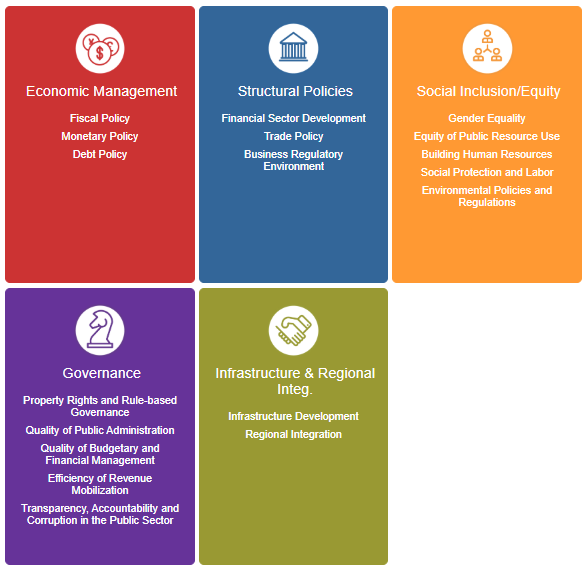
Each country's performance scoring is assessed against a questionnaire of 18 criteria, grouped on 5 clusters based on:
- Coherence of its economic management;
- Coherence of its structural policies;
- Degree to which its policies and institutions promote equity and social inclusion;
- Quality of its governance and public sector management; and
- Degree to which its regulatory framework is enabling infrastructure development and regional integration.
Scores
For each country, the outcome of the CPIA exercise yields an overall score. This score is an average of all scores assigned across the 18 criteria of the questionnaire. All scores range between 1 (very weak) and 6 (very strong) and are updated every two years for all the 54 African countries.
Process
The CPIA exercise generally starts around mid-September and concludes by end of November of the same year. It comprises 4 main phases:
- The first phase consists in the preparation of first CPIA evaluation drafts by country teams. By mid-October, for each country, tentative scores and evaluations notes are entered and submitted through the CPIA platform for every single sub-criteria of the questionnaire.
- The second phase gives the floor to sector experts and independent peer reviewers who can comment and provide guidance to country teams on real time basis through the CPIA platform. This phase specifically helps Country Economists to fine-tune the notes and ensure adequate alignment between proposed scores and the general guidelines of the CPIA questionnaire.
- The third phase deals with the preparation of the second CPIA drafts where country teams are requested to revise their qualitative and quantitative evaluations, taking into account concerns raised the by peer reviewers. By mid-November, all revised CPIAs are submitted in the platform.
- The fourth phase evolves coordinators of the exercise, Management of the Bank's Regional Departments, and country teams who seat together to endorse CPIA evaluations. The purpose of this phase is to build Management's ownership of the produced evaluations and ensure coherence of CPIA scores and rankings at continental, regional and country level before their release.
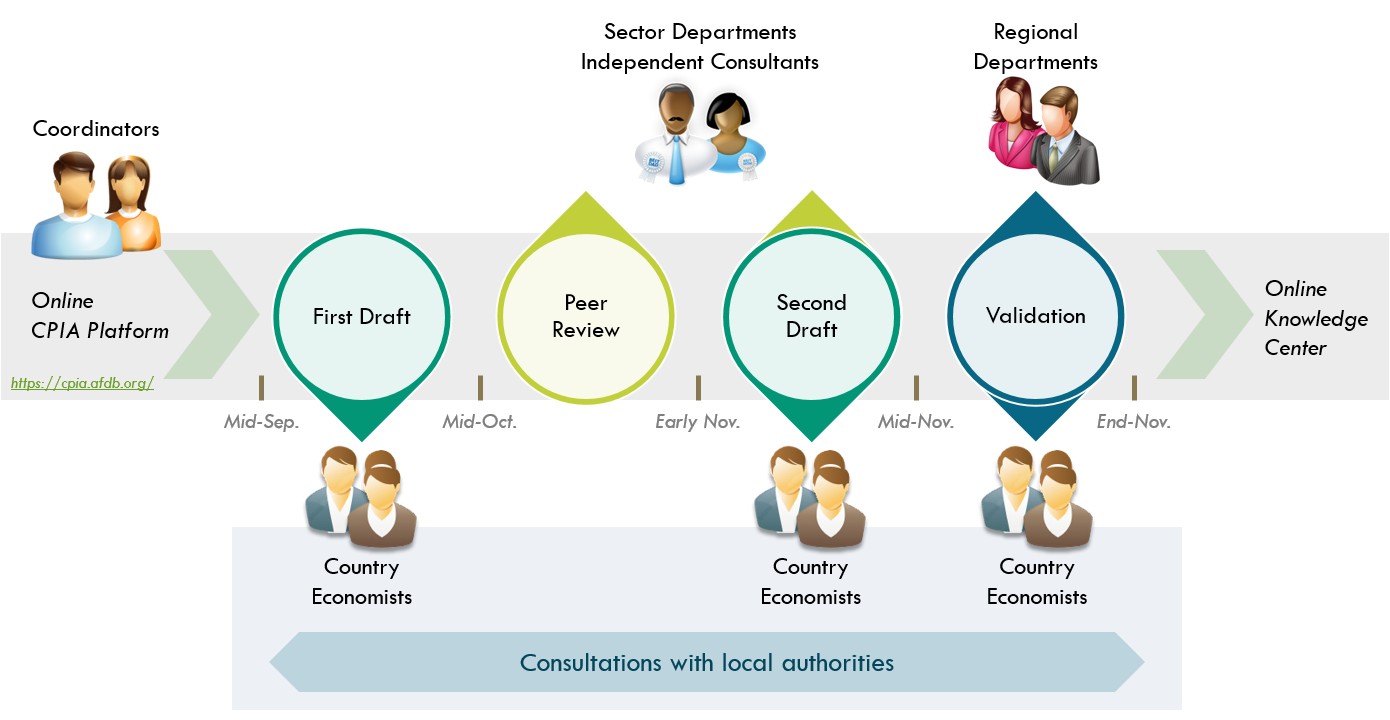
Along-side with the whole CPIA preparation exercise, country teams undertake continuous internal and external consultations with sector Departments - from the Bank's side - and key governments' institutions and local authorities (such as ministries, institutes, and regulation bodies) - from the country's side.
The purpose of these consultations is twofold: to increase countries' ownership of the CPIA, and to access up-to-date and relevant information from governments on their efforts to put in place good policies and efficient institutions. CPIA scores and rankings of countries eligible for the African Development Fund (ADF) are publically disclosed by the Bank though the CPIA Platform right after the internal release of their allocations, generally by end of January of each year. Scores of non ADF-eligible countries are not disclosed publically.
Usage
The CPIA is the bedrock of the AfDB Performance-Based Allocation (PBA) system of ADF resources, based on the principle that aid is most effective in accelerating economic growth and poverty reduction in countries where policy and institutional performance is strong. Thus, the CPIA is an excellent dialogue tool with authorities and other stakeholders in Regional Member Countries (RMCs). The scores are also used internally by the Bank, among other things to help guide its interventions, its assessments of risk, and its research.
In addition, following the combination of the CPIA with the African Economic Outlook (AEO) in 2011, the structure of the CPIA questionnaire has been streamlined and adapted to allow a better integration and complementarity with that of the AEO report.